
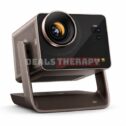
The Vidda C5 Master (2026) is one of Hisense’s most ambitious flagship projectors, bringing several interesting technologies to the premium home theater market. Its biggest highlights include an MCL3A + Qualas 42 hybrid laser light engine, an advanced liquid-cooling system, a physical adjustable iris, and a versatile optical lens system.
With an advertised brightness of 5,800 CVIA lumens and a claimed native contrast ratio of 8,000:1, the C5 Master looks impressive on paper. But how does it actually perform? Are its advanced technologies worth the investment, and are there any drawbacks you should know about?
Let’s take a closer look at its specifications, real-world measurements, advantages, and disadvantages based on the detailed video review by the Ukrainian YouTube channel Tviy Proector.
Vidda C5 Master (2026) – Key Specifications
- Model: Vidda C5 Master (2026)
- Display Technology: 0.47-inch DMD (SST architecture)
- Resolution: 4K UHD
- Light Source: MCL3A + Qualas 42 Hybrid Laser
- Brightness: 5,800 CVIA Lumens (claimed)
- Measured Brightness: 5,218 ANSI Lumens
- Native Contrast: 8,000:1 (claimed)
- Dynamic Contrast: Up to 4,000,000:1 (claimed)
- Cooling System: Ice Turbo Ice Seal Liquid Cooling
- Physical Iris: 7-Level Adjustable Aperture (F2.0–F6.0)
- Optical Zoom: 2× Optical Zoom
- Throw Ratio: 0.85:1–1.7:1
- Lens Shift: ±120% Vertical / ±47% Horizontal
- Maximum Refresh Rate: 240Hz at 1080p
- Audio System: 2.1-channel JBL with Integrated Subwoofer
- Audio Technologies: Dolby Audio, DTS:X, Viper Audio, Hi-Res Audio Gold
- HDMI: 2 × HDMI 2.1 (1 × eARC)
- USB: 2 × USB 3.0
- Network: Gigabit Ethernet, Wi-Fi 7
- Other Connections: Optical SPDIF, 3.5mm Audio Out
- Power Consumption: 280W (measured peak)
- Weight: 10.3 kg
1. Product Overview
- Reviewed Device: Vidda C5 Master (2026 Flagship Model) by Hisense / Vidda.
- Design & Build: Dark titanium metal finish (
Kingkoall-metal chassis), glossy front face, massive glass optical lens, and a Gimbal swivel stand with an integrated subwoofer. - Light Engine: MCL3A primary triple-laser unit blended with a Qualas 42 laser module.
- DMD Display Chip: 0.47-inch DMD on SST architecture for faster micro-mirror state switching.
- Thermal System: Ice Turbo Ice Seal liquid cooling with seamless Teflon tubes.
- Physical Iris & Optics: 7-level variable physical hardware iris (F2.0–F6.0); 2 x optical zoom (0.85:1 – 1.7:1 throw ratio); lossless mechanical lens shift (±120% V, ±47% H).
- Audio & Connectivity: 2.1 JBL sound system certified with Hi-Res Audio Gold, Dolby Audio, DTS:X, and Viper Audio. Includes 2x HDMI 2.1 (1 with eARC), 2x USB 3.0, 1Gbps LAN port, Optical SPDIF, 3.5mm audio out, and Wi-Fi 7.
2. Real-World Testing & Benchmarks
All benchmarks were measured on a 120-inch ALR Fresnel screen under controlled room conditions (39.0 dB baseline noise / 21.4°C room temp).
Measured ANSI Brightness Output
- Max Brightness (Iris OFF, Level 10): 5,218 ANSI lm (Manufacturer Claim: 5,800 CVIA lm)
- Brightness Equalization Mode: 2,115 ANSI lm (vs UltraMax 1,892 ANSI lm)
- Dark Precision Mode: 870 ANSI lm (vs UltraMax 663 ANSI lm — +31.2% increase)
Noise & Thermal Readings
- Noise at Startup: 39.5dB
- Noise at 45 Minutes: 45.8dB
- Noise Stabilized (3 Hours): 41.7dB (vs air-cooled UltraMax: stable 44dB, peaks up to 50dB)
- Surface Temperature (3 Hours): 40.5°C
Audio & Power Draw
- Peak Audio Volume: 108.2dB (vs UltraMax 111.0dB)
- Peak Power Consumption: 280 Watts
3. Important Observations
- “Schrödinger’s Dynamic Contrast”: The reviewer clarified that dynamic power switching is working when
Iris OFFis selected, but software bugs prevent it from engaging when the physical iris is stepped down. - Hunt Effect Compensation (DeepBlack & Oasis AI): Closing the physical iris reduces perceived color richness (the Hunt Effect). Vidda’s dynamic engines dynamically adjust 3D-LUT color mapping and enhance local highlight sharpness to preserve visual depth.
- Comparison with Competitors (Dangbei S7 UltraMax): Unlike older hybrid designs that suffered from poor color accuracy due to 50/50 laser splits, Vidda uses the MCL3A as the primary engine while Qualas 42 acts purely as a fine-tuned optical color compensator.
- Rushed Firmware Release: The reviewer notes that intense market competition led Vidda to release three models (C3, C3 Alpha, C5) within one year, resulting in launch-day firmware oversights that will require post-launch software updates.
4. Overall Conclusion
- Strongest Aspects: Excellent color performance with significantly reduced laser speckle, relatively quiet liquid cooling performance, high real-world brightness (5,218 ANSI lm), and versatile optical lens shift.
- Weakest Aspects: Firmware bug disabling dynamic contrast when physical iris is closed, subwoofer cabinet vibration at high volumes, and VRR resolution scaling drops.
- Who Should Buy It? Enthusiasts building dedicated home theaters, users projecting on massive screens (>120 inches), or rooms requiring daytime brightness and low operating noise.
- Is It Worth Buying? Yes. The physical hardware platform (liquid cooling, optical optics, hybrid color tuning) is among the best available. Provided Vidda fixes the dynamic contrast iris firmware bug in upcoming updates, it stands out as one of the most capable long-throw projectors on the market.
The Vidda C5 Master is a high-end projector that combines advanced display technology, impressive brightness, and sophisticated cooling to deliver a premium home cinema experience.
- Class-Leading Speckle Control: The MCL3A + Qualas 42 hybrid engine breaks optical coherence, virtually eliminating laser speckle noise. Fine details and text remain exceptionally sharp.
- Ultra-Quiet Liquid Cooling: The Teflon-tube liquid system maintains stable, predictable thermal performance without annoying noise spikes (41.7dB stabilized vs. air-cooled models that spike to 50dB).
- Massive Measured Brightness: Delivers a measured 5,218 ANSI Lumens at peak output, allowing for huge screen sizes (>120 inches) and Improved visibility in ambient light.
- Lossless Physical Setup: Mechanical lens shift and optical zoom eliminate the need for digital keystone cropping, preserving full resolution and low input lag.
- Rich Gaming Capabilities: Supports up to 240Hz at 1080p, dynamic latency modes, Black Gain shadow equalizer, and AI Super Resolution.
- Consistent Color Stability: Liquid cooling prevents laser temperature drift, keeping white balance and saturation consistent across different brightness levels.
- Premium Build Quality: Features a dark titanium metallic body, smooth Gimbal adjustment, and a backlit metal-faced remote control.
- Firmware Limitation on Dynamic Contrast: Dynamic contrast cannot function simultaneously with the physical aperture closed (F3.0–F6.0). It only runs when the iris is completely open (Iris OFF), hurting black depth on closed-iris settings compared to older models.
- Subwoofer Cabinet Resonance: Heavy bass above 50-55% volume causes vibrations that can micro-shake the projected image unless securely mounted or bass output is turned down.
- Resolution Drop with VRR/FreeSync: Enabling Variable Refresh Rate or AMD FreeSync Premium automatically forces display resolution down to 2K (1440p/1080p).
- Limited Port Selection: Only 2 HDMI ports are available—connecting an eARC soundbar and a gaming console leaves no room for a streaming box without a splitter.
- Slower Initial OS Boot: System UI initialization takes 13 seconds (vs 7 seconds hardware start) due to heavy real-time image processing algorithms loading.
- Heavy and Bulky: Total weight is 10.3 kg with a massive external power brick, limiting real-world portability.
- Overstated Marketing Contrast: Advertised "4,000,000:1 dynamic contrast" claims are unrealistic marketing exaggeration.
The reviewer in the video (Tviy Proector) does not assign a numerical score out of 10 to the Vidda C5 Master.
Instead of an arbitrary rating, the review evaluates the projector qualitatively:
- Hardware & Build (9.5/10 Equivalent): Praised as one of the best engineered projectors on the market—highlighted by its whisper-quiet liquid cooling, class-leading reduction of laser speckle, and physical optical lens shift/zoom.
- Software & Tuning (6.5/10 Equivalent): Criticized for a rushed launch firmware—specifically the inability to run dynamic contrast while closing the physical iris, VRR resolution drops, and minor subwoofer cabinet vibration at high volumes.
Video Review Verdict
The reviewer concludes that the Vidda C5 Master is currently one of the top high-end projectors on the market. If forced to translate the review’s sentiment into a single number, it stands at a solid 8.5 / 10—a top-tier hardware platform slightly held back by early launch firmware bugs that are expected to be patched in future updates.
Where To Buy VIDDA C5 Master?
Founder, CEO, Editor-in-Chief. I have been creating technology related websites and platforms since 2011. My main project right now is Deals Therapy. I want to help people save money, time and effort when buying electric bicycles, electric scooters, projectors, smartphones, robot vacuum cleaners and other products. I am fanatical about what I do because I believe I am doing a useful and necessary thing.
